
Vitamins D3 plus K2 – Bone & Heart Support
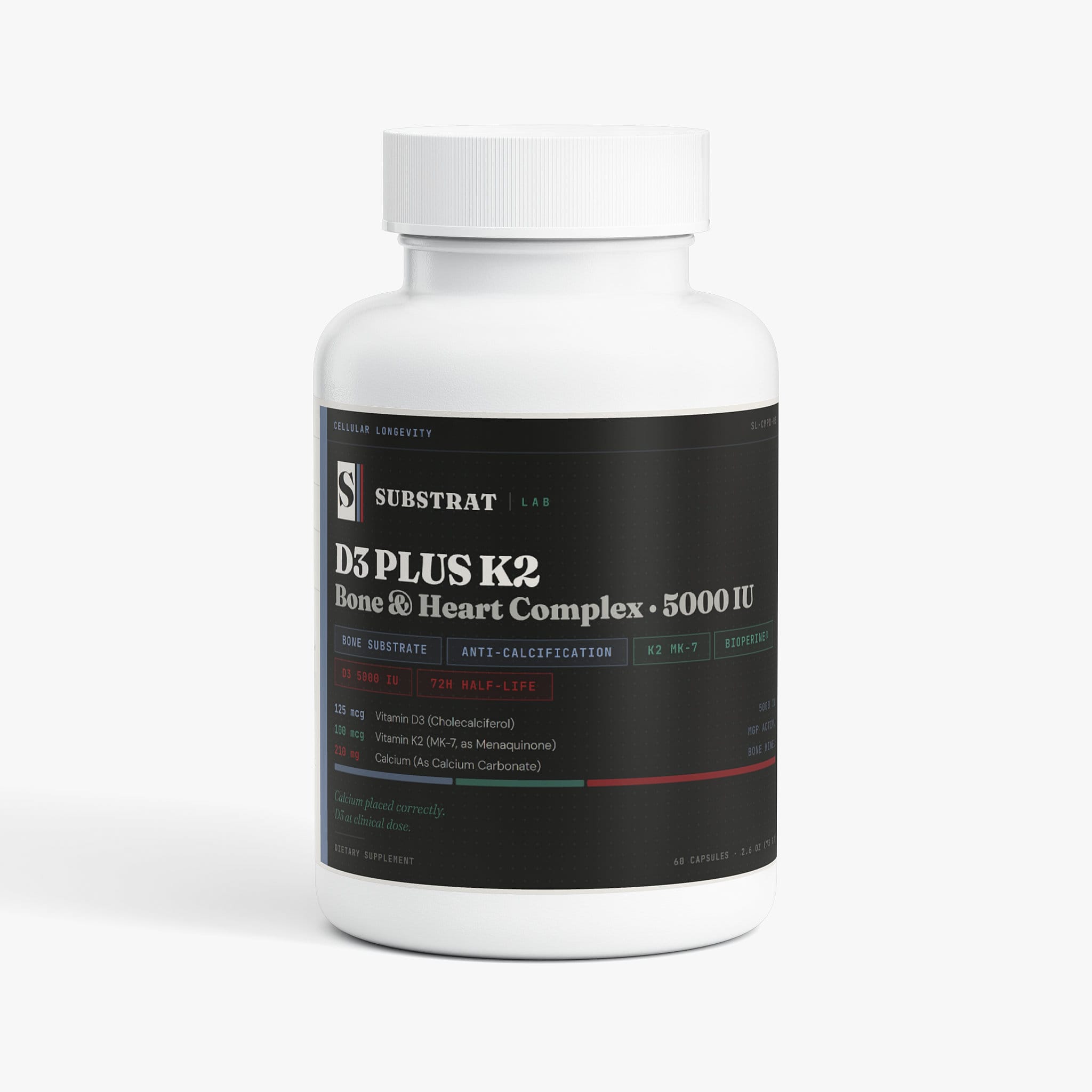
D3 + K2
The two fat-soluble vitamins most people are deficient in. D3 at 5000 IU. K2 as MK-7 — the 72-hour form. Calcium directed by MGP. Full-disclosure label.
- D3 5000 IU direct — 125 mcg Cholecalciferol, not the common underdosed 400–1000 IU most supplements use
- K2 as MK-7 — menaquinone form with 72h plasma half-life; MK-4 lasts 1–2h and requires multiple daily doses for the same effect
- BioPerine® 5 mg — patented piperine extract at the tested dose; inhibits efflux transporters that reduce fat-soluble vitamin absorption
- Full-disclosure label — every dose declared, no blend hiding underdosed actives behind a proprietary stack
Vitamin D3 and Vitamin K2 MK-7 are the two most commonly under-dosed fat-soluble vitamins — often formulated together but rarely at clinical doses. D3 at 5000 IU (125 mcg) drives calcium absorption from the gut. K2 as MK-7 — the menaquinone form with a 72-hour plasma half-life, not the short-acting MK-4 — activates Matrix Gla Protein (MGP) to direct that calcium into the bone matrix and away from artery walls. BioPerine® at 5 mg ensures fat-soluble absorption. Calcium carbonate provides the mineral substrate. No underdosing. No proprietary blend.
Silent and cumulative: vitamin D deficiency affects an estimated 40% of adults in northern latitudes. The consequence isn't dramatic — it's slow calcium dysregulation, declining bone mineral density, and the kind of cardiovascular calcification that takes decades to show on a scan. K2 deficiency compounds it: D3 without K2 absorbs calcium but cannot place it correctly.
Vitamin D3 activates calcium transport proteins in the gut — without adequate D3, dietary calcium largely passes through regardless of intake. At 5000 IU daily, D3 drives sustained calcium absorption. This is the upstream step the rest of the formula builds on.
Calcium absorbed without K2 has nowhere to go reliably — it can deposit in artery walls and soft tissue. MK-7 activates Matrix Gla Protein (MGP), the body's primary anti-calcification mechanism: directing calcium into the bone matrix, suppressing arterial deposits. MK-7's 72-hour half-life means one daily capsule sustains this activation around the clock. MK-4 — used in cheaper K2 supplements — has a 1–2 hour half-life.
This is not a recovery supplement. The outcomes — bone mineral density, arterial flexibility, reduced calcification risk — are measured over years in DEXA scans and cardiovascular markers, not in subjective wellness. For people in their 30s and 40s who understand that interventions for long-term health are almost entirely invisible in the short term.
Peer-reviewed signals on Vitamin D3, K2 MK-7, and their combined effect on bone and vascular substrate — mechanism, not wellness marketing.
Four ingredients. Two vitamins at clinical dose. One absorption enhancer. One mineral substrate.
Three distinct mechanisms, one substrate target: calcium placed correctly in bone, kept out of arteries.
Cholecalciferol converts to calcitriol in the kidney — the active hormone that upregulates calcium-binding proteins in the gut lining. Without adequate D3, calcium from food and supplements is poorly absorbed regardless of intake. At 5000 IU, D3 drives a clinically active systemic level for most adults, making calcium absorption efficient and sustained.
Activated by K2, Matrix Gla Protein (MGP) is the body's primary inhibitor of vascular calcification. It binds free calcium in circulation and prevents deposition in artery walls and soft tissue. MK-7's 72-hour plasma half-life means one daily capsule sustains MGP activation continuously. MK-4 — the other K2 form — has a 1–2 hour half-life; clinical studies on bone outcomes use MK-7 specifically.
Piperine from black pepper extract at 5 mg (the BioPerine® standardized dose) inhibits intestinal P-glycoprotein and CYP3A4 — efflux mechanisms that flush fat-soluble compounds out of the intestinal wall before absorption. D3 and K2 are both fat-soluble; their uptake is directly affected by these transporters. Including BioPerine® at the tested dose addresses absorption at the wall, not just at the meal.
The fat-soluble absorption chain activates. With consistent daily use alongside a fat-containing meal, D3 and K2 plasma levels begin to rise. No subjective signal at this stage — the substrate loads silently.
Systemic D3 levels approach the optimal range (40–80 ng/mL) for most adults at 5000 IU/day. K2 MK-7's MGP activation is sustained continuously. Calcium begins being directed more efficiently — no observable sign of this from the outside.
Bone metabolism shifts. Osteocalcin carboxylation — K2-dependent — improves, indicating calcium is being incorporated into bone matrix rather than circulating freely. Long-term tissue adaptation. Not a noticeable event, but the substrate is moving.
The relevant outcomes are measured in years: DEXA scan density, arterial flexibility markers, cardiovascular calcification risk. This is a permanent substrate intervention, not a cycle — deficiency reinstates within weeks of stopping. The longer the run, the clearer the return.
Bone and vascular substrate — outcomes measured in years, not weeks. Individual response varies.
One capsule twice daily with a fat-containing meal — D3 and K2 are fat-soluble, absorption is significantly higher with dietary fat. Morning and evening is the default split. BioPerine® is effective across both doses. If you miss the evening dose, taking both at one meal is better than skipping. Consistent daily use matters more than timing precision — deficiency reinstates quickly on gaps.
Peer-reviewed. On all four actives.
A 3-year RCT (n=3,270 elderly women) demonstrated that daily Vitamin D3 (800 IU) + calcium supplementation was associated with significantly reduced hip fracture rate and preserved femoral neck bone mineral density vs placebo. The trial established D3+calcium as the foundational evidence base for bone mineral density support in aging adults — the most replicated finding in bone health supplementation.
Chapuy MC et al. N Engl J Med. 1992;327(23):1637–1642. PMID 1331788 ↗A 3-year randomised, double-blind, placebo-controlled trial (n=244 healthy postmenopausal women) found that 180 mcg/day MK-7 significantly preserved lumbar spine and femoral neck bone mineral density vs placebo — BMD decreased in the placebo group and was maintained in the MK-7 group, with a statistically significant between-group difference from year 1. The only long-duration bone RCT using MK-7 specifically at this dose range.
Knapen MHJ et al. Osteoporos Int. 2013;24(9):2499–2507. PMID 23525894 ↗A 24-month clinical trial (n=172 postmenopausal women with osteopenia/osteoporosis) compared K2+D3 combined therapy to D3 alone. Lumbar vertebral BMD increased significantly in the combined group while the D3-only group showed continued decline — direct evidence that K2 adds a measurable benefit to D3's bone effect beyond what D3 achieves independently.
Ushiroyama T et al. Maturitas. 2002;41(3):211–221. PMID 11886767 ↗A double-blind clinical trial demonstrated that co-administration of 5 mg BioPerine® (standardized piperine) with CoQ10 — a fat-soluble compound with analogous absorption kinetics to Vitamins D3 and K2 — significantly increased plasma bioavailability vs CoQ10 alone. Mechanism: inhibition of intestinal P-glycoprotein and CYP3A4 efflux transporters that reduce fat-soluble compound absorption at the gut wall.
Badmaev V et al. J Nutr Biochem. 2000;11(2):109–113. PMID 10715596 ↗i was at 22 ng/ml d3 — technically "normal" by most lab ranges. except 22 is deficiency territory if you look at actual research (optimal is 40–80). six months at 5000 iu/day, retested: 58 ng/ml. the form matters: cholecalciferol, not ergocalciferol. the k2 as mk-7 is the piece most d3 supplements skip. the half-life difference (72h vs 1–2h for mk-4) is real and documented.
spent too long on cheap d3+k2 combos using mk-4. checked the half-life data — mk-4 is fine if you dose 3x/day, nobody does that. mk-7 at 100mcg once daily covers you. three months in, got osteocalcin carboxylation checked privately. you won't feel this working. that's the point.
d3 and k2 are the most documented supplements in the longevity literature. 5000 iu is the dose that actually moves bloodwork. this product doesn't oversell it — no mood claims, no "revitalizing" language, just what's in the capsule. clean. minus one star: twice a day is annoying and i forget the evening dose.
started watching qoves for bone structure and facial development content. fell into the longevity research from there. read the knapen 2013 osteoporosis international paper — mk-7 preserved femoral neck and lumbar bmd vs placebo over 3 years. 100mcg is the dose used in that trial. this formula runs exactly that. 31 years old, taking it permanently.
five months in. no subjective feeling, which is expected — bone turnover is a years-long process. what i do have: d3 at 61 ng/ml on bloodwork (was 31 two years ago on a lower-dose product). dexa baseline done, will retest in 12 months. bioperine is doing its job on the absorption side. not exciting. exactly what i wanted.
already running nad+ for the mitochondrial axis. added d3+k2 because the bone and vascular substrate research is too consistent to ignore. both substrat, same label standard, no hidden doses. one month in, nothing to report subjectively. that's how this works. will check bloodwork at 3 months.