
CoQ10 Ubiquinone
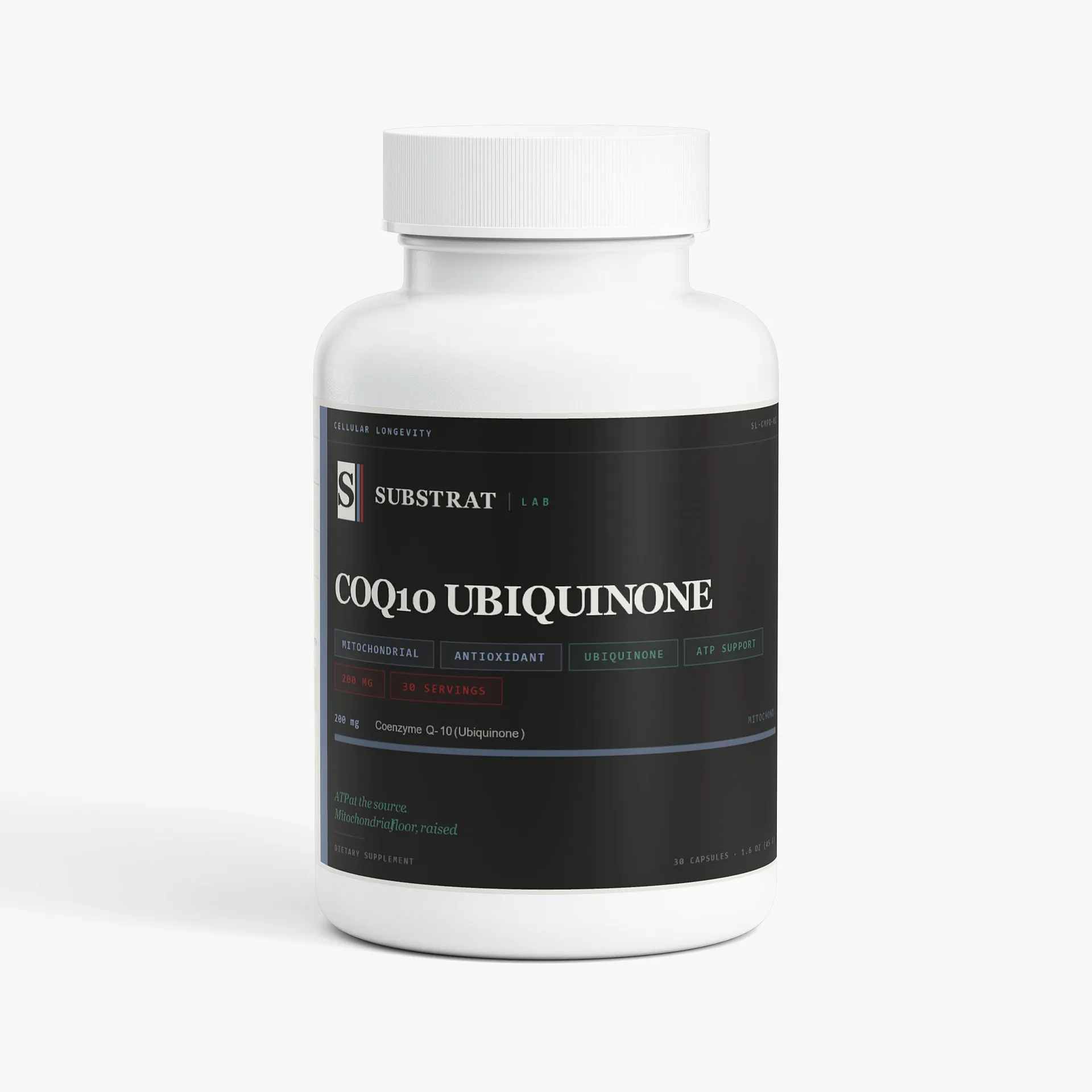
CoQ10 Ubiquinone
The electron transport chain can't run without it. 200mg. One capsule.
- Mitochondrial ATP support — the electron transport mechanism, directly
- Exercise recovery — reduced muscle-damage markers across 28 RCTs
- Cardiovascular substrate — the most-studied supplement in clinical heart failure trials
- Statin compensation — statins deplete endogenous CoQ10 via the same HMG-CoA pathway
Coenzyme Q10 is a cofactor at the inner mitochondrial membrane — it shuttles electrons between complexes I/II and III, driving the proton gradient that synthesises ATP. Endogenous production starts declining around 25. Statins block the same biosynthetic pathway, accelerating that depletion. 200mg of the Ubiquinone form. One capsule. Rice flour and a vegetable capsule shell. Nothing else that matters.
Low-level energy drag that coffee doesn't fix, recovery that takes longer than it should after training, a background fatigue that started somewhere in your mid-twenties — often a mitochondrial substrate issue, not a lifestyle one.
CoQ10 is not an energy drink — it's a cofactor in the machinery that produces ATP. Without it, electron flow stalls at mitochondrial complexes I and III and ATP synthesis drops.
During intense exercise, reactive oxygen species spike at the mitochondrial membrane. CoQ10 in its reduced form (ubiquinol) scavenges those ROS before they damage cell membranes and muscle tissue.
If you're on a statin, CoQ10 repletion addresses an iatrogenic deficiency — the drug creates it. If you train hard or want the mitochondrial floor higher, the clinical evidence is consistent across multiple independent programmes.
Peer-reviewed signals across fatigue, exercise recovery, and cardiovascular substrate — mechanism confirmed in multiple independent RCT programmes.
One active. One capsule. Full dose, nothing hidden.
One molecule. Three distinct roles in the mitochondria.
CoQ10 accepts electrons from complexes I and II at the inner mitochondrial membrane and donates them to complex III — the transfer that drives the proton gradient powering ATP synthase.
In its reduced ubiquinol form, CoQ10 neutralises reactive oxygen species directly at the mitochondrial membrane — the site of highest ROS exposure in the cell, protecting against oxidative damage.
HMG-CoA reductase inhibitors (statins) block the mevalonate pathway — the same biosynthetic route the body uses to produce CoQ10. Statins lower both LDL cholesterol and CoQ10 simultaneously.
Energy fluctuations tend to smooth out first — fewer late-afternoon dips. Some notice faster warm-up at the start of training sessions.
Recovery between sessions typically improves. Muscle soreness duration shortens. The chronic fatigue floor starts to shift.
The mitochondrial substrate effect accumulates — sustained energy output settles at a higher baseline. Less noticeable day-to-day, more noticeable when you stop.
Long-game compound. CoQ10 has the most robust long-term evidence of any mitochondrial supplement. The rationale for permanent daily inclusion is stronger than most.
Typical, compound-based expectation — not medical advice. Individual response varies, particularly for statin users who may notice more pronounced improvement.
One capsule daily, with a fat-containing meal — Ubiquinone is fat-soluble. Morning is the default. 200mg is within the established clinical dosing range (100–400mg depending on indication in the literature). If you are on statins, this is the highest-priority single compound in the Cellular Longevity category.
Peer-reviewed. On the exact molecule.
CoQ10 supplementation significantly reduced fatigue scores compared with placebo across 13 randomised controlled trials (n=1,126) — Hedges' g = −0.398, p = 0.001.
Zhu J et al. Evid Based Complement Alternat Med. 2022;2022:5060923 ↗In a GRADE-assessed dose-response meta-analysis of 28 RCTs (830 subjects), CoQ10 significantly decreased creatine kinase, LDH, myoglobin, and malondialdehyde — biomarkers of exercise-induced muscle damage and oxidative stress.
Systematic review & dose-response meta-analysis. Phytomedicine Plus. 2024 ↗A meta-analysis of 45 RCTs showed CoQ10 administration significantly reduced systolic blood pressure in adults — confirming its cardiovascular substrate role beyond the mitochondrial energy axis.
Effects of CoQ10 administration on blood pressure and heart rate in adults. PMC12150111. 2025 ↗CoQ10 supplementation in coronary artery disease patients on statins significantly reduced malondialdehyde and improved superoxide dismutase activity vs placebo — supporting its use as statin-induced depletion compensation.
Lee BJ et al. Nutr J. 2012;11:56 ↗been on rosuvastatin since 26, no one ever mentioned coq10. read about the mevalonate pathway depletion on examine and was pretty annoyed nobody flagged it. 8 weeks in now — the low-level fatigue i'd been blaming on work hours is genuinely better. hard to know exactly what's doing what, but the mechanism is real and confirmed, so i'm staying on it.
went down a longevity reading phase last winter — coq10 kept coming up in the actual research, not just the biohacker marketing. 200mg daily for 6 weeks, recovery is noticeably faster after lifting. legs don't drag as bad the day after heavy squats. clean label, one active that matters, easy morning habit.
three months in. this isn't a compound where you feel it on day one. but i ran out for 2 weeks waiting on restock and that's when i noticed — energy was slightly more variable, gym output dipped a bit. sometimes you only know something's working when you stop taking it. 4 stars because the effect is real but undramatic, which is what it should be.
stopped buying supplements based on marketing 2 years ago. coq10 at 200mg is within the studied range, the electron transport mechanism is textbook, ubiquinone is the form with the longest research record. substrat doesn't oversell it which is actually why i trust the label. 6 weeks in, energy between sets is better, mid-afternoon dip is basically gone.
started coq10 and nad+ same week so i can't fully attribute what's what. but objectively less drained by 3pm than i was a month ago and recovery has improved. resting heart rate dropped 4bpm over 8 weeks, which i track. can't claim causation but something is working. minus one star for not being disciplined enough to single-compound it first.
turned 30, decided to actually read what I was taking instead of vibes-buying. coq10 is one of the few compounds where the evidence is boring in the best way — consistent across studies, clear mechanism, no hype. noticed the energy floor stabilise around week 5. exactly what it says on the tin. adding it to the permanent rotation.