
Maca Plus – Triple Spectrum
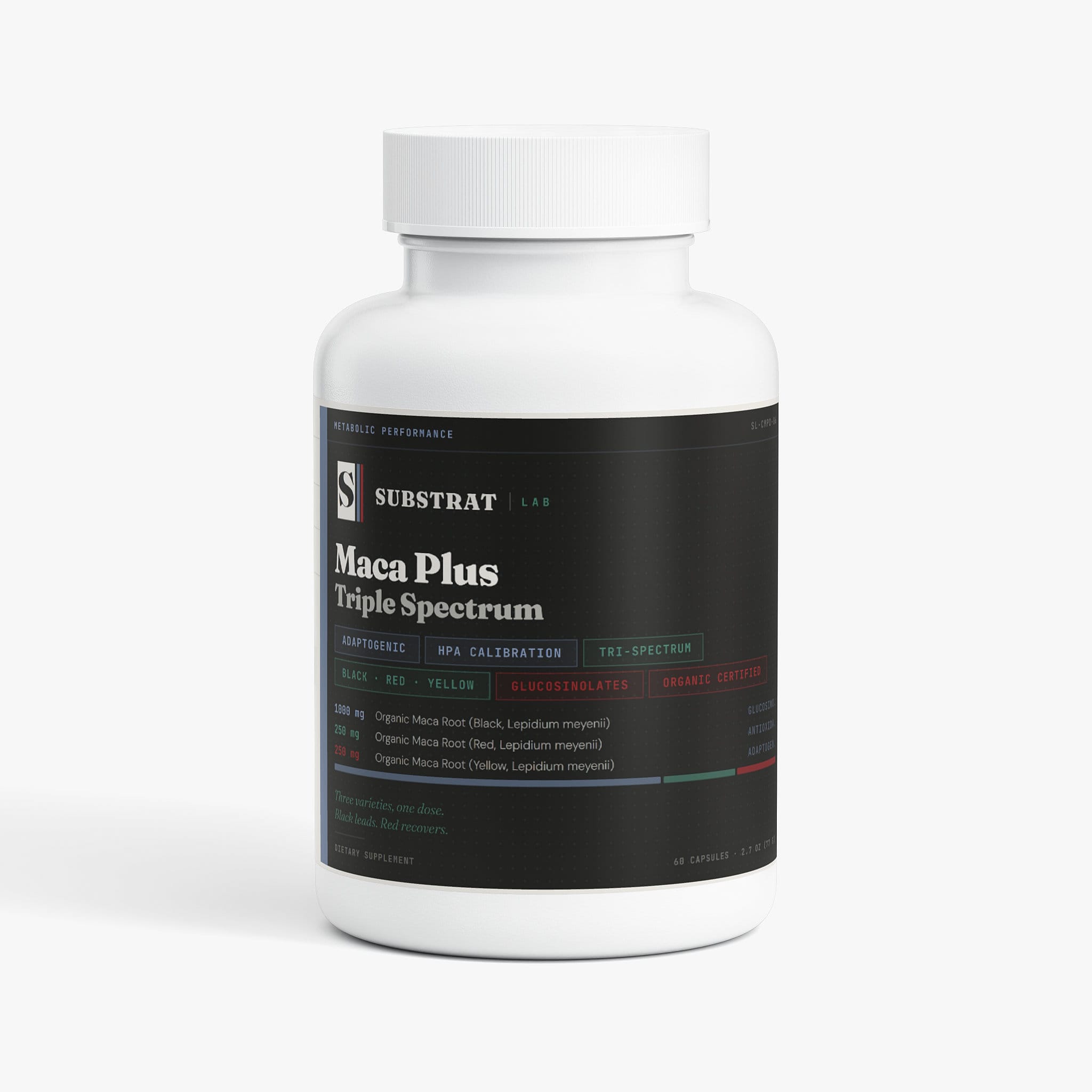
Maca Plus - Triple Spectrum
Black, red, and yellow maca — 1500 mg organic, the varieties single-colour products skip.
- Black Maca 1000mg — the highest-glucosinolate variety, studied for energy
- Red Maca 250mg — top antioxidant load, the recovery and hormonal axis
- Yellow Maca 250mg — the clinical baseline variety, organic
- 1500mg total — inside the studied range, no proprietary blend
Most maca is one cheap variety — underdosed yellow. This stacks Black 1000 mg (energy), Red 250 mg (recovery), Yellow 250 mg — 1500 mg organic, every dose declared.
Single-variety yellow at 500 mg is the market default — the cheapest root, missing the strongest profiles. This runs all three at 1500 mg, black-led.
Black carries the highest glucosinolate density — the compounds studied for energy and anti-fatigue. At 1000 mg it's the dominant active, not a token dose.
Red brings the highest antioxidant load and the most specific data on the hormonal field and post-exercise recovery — the axis black doesn't cover.
No caffeine, no day-one hit. The mechanism is HPA-axis modulation over weeks — stable energy, not a spike. Endpoints land at 8–12 weeks.
Peer-reviewed signals from human trials on black maca, combined maca, and exercise performance.
Four ingredients. Three organic maca varieties totalling 1500 mg. Black pepper for absorption.
Adaptogenic: HPA axis modulation over weeks. Phytochemical tri-spectrum — three varieties, three distinct profiles.
Maca's bioactives are glucosinolates — benzylglucosinolate in black — and their isothiocyanate metabolites. They modulate the HPA axis; the effect builds over weeks. Black at 1000 mg delivers the highest dose.
Black = highest glucosinolate (energy), red = highest antioxidant (recovery, hormonal), yellow = clinical baseline. Single-variety products miss two of the three axes.
Piperine at 5 mg inhibits the gut-wall efflux transporters that clear botanical compounds before absorption — the standard dose from bioavailability studies.
No acute signal — maca isn't a stimulant. Two capsules each morning with food. The compound is loading.
Glucosinolate metabolites accumulate. Baseline cortisol rhythm steadies — fewer late-morning and mid-afternoon crashes. Recovery may improve.
The primary endpoint window in maca trials — stamina, performance, and energy improvements land here.
Sustained adaptogenic calibration. No cycling needed; discontinuation reverses it within weeks. A permanent substrate.
Adaptogenic effect — cumulative over 4–12 weeks. Not a stimulant. Individual variation applies.
Two capsules daily with a morning meal. Food improves tolerance (maca at high dose on an empty stomach can cause nausea in sensitive individuals). Morning is preferred: the energy-axis adaptogenic effect integrates with the day's metabolic load rather than interfering with sleep architecture. For exercise performance: taking 30–45 minutes before training is an option, but the clinical benefit is built over weeks of cumulative intake, not from any single pre-dose. Consistent daily use matters more than timing precision.
Peer-reviewed. Black maca, combined maca, exercise performance.
RCT (n=175 men, sea level + altitude, 12 weeks): both black and red maca extracts improved self-reported energy, mood, and well-being vs placebo — black stronger on energy, red on the hormonal axis.
Gonzales GF et al. Evid Based Complement Alternat Med. 2016;2016:4394261. PMC5039502 ↗Double-blind crossover in active men: maca significantly improved sport-specific stamina and reduced fatigue markers vs placebo — consistent with the anti-fatigue animal-model data.
Zhang Y et al. J Int Soc Sports Nutr. 2025. PMID 40960048 ↗12-week DB-RCT in active men (2.25 g twice daily): post-exercise IFN-γ was significantly higher vs placebo — a marker of maintained immune resilience under high training load.
Tsai CS et al. Front Nutr. 2025. PMC11704699 ↗Systematic review of 17 databases: all 4 qualifying RCTs showed improved sexual desire vs placebo in men and women — directionally consistent on the hormonal-libido axis.
Shin BC et al. BMC Complement Altern Med. 2010;10:44. PMID 20691074 ↗checked examine first. maca's energy data is on glucosinolates — benzylglucosinolate in the black variety. most products don't name the variety, so you're buying yellow, the lowest. this declares all three. 1000mg black is the one that matters. six weeks in, morning energy is steadier — no peak, no crash.
two years on single-variety yellow, never noticed much. black vs yellow is not a small glucosinolate difference. switched week 1, by week 7 morning drive and recovery are clearly better. might be partly bias, staying on it regardless.
took 6 weeks to notice, which is what the research says. stacking with withania — different paths, withania is cortisol, maca is glucosinolate. the energy is absence-of-fatigue, not a boost. 4 stars: real but subtle, wrong product if you want to feel it acutely.
5 sessions a week. by week 9, soreness cleared faster and back-to-back days stopped being a dread. not dramatic, but repeatable. the endurance/anti-fatigue data points the right way. running it with the coq10.
looked into red maca after buying — the pmc5039502 study split black vs red, red is more specific to the hormonal field and antioxidants. 250mg isn't dominant but it's declared. the three-way split matches the literature.
qoves rabbit hole → bone structure → cortisol → HPA axis → here. maca kept showing up as an adaptogen with a different mechanism than ashwagandha. stacked both. 10 weeks in, most stable energy i've had in years. placebo or not, i don't care.